
Last updated September 20, 2026
Full 25-point door and opener safety check with every visit - springs, cables, rollers, tracks, and your LiftMaster or Chamberlain opener included
You get a price before we start. It does not change when the truck arrives.
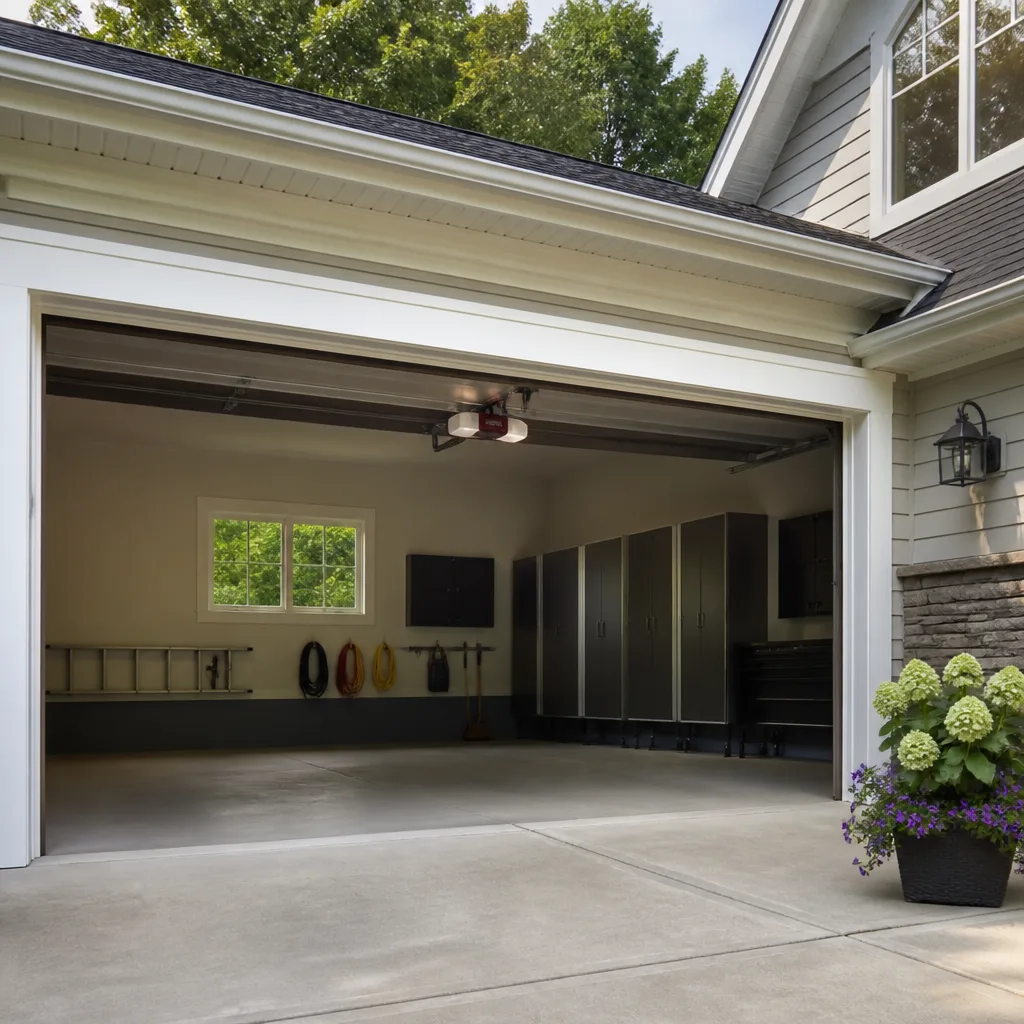
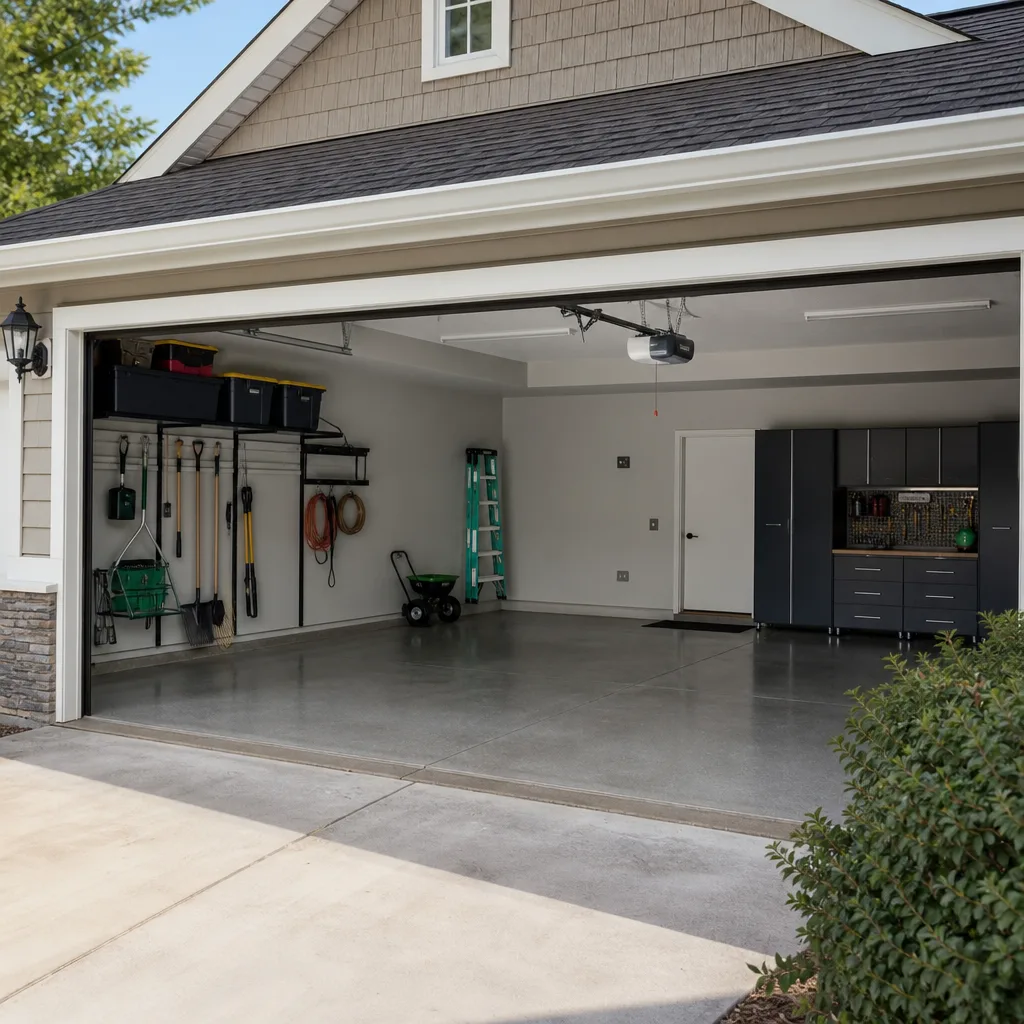
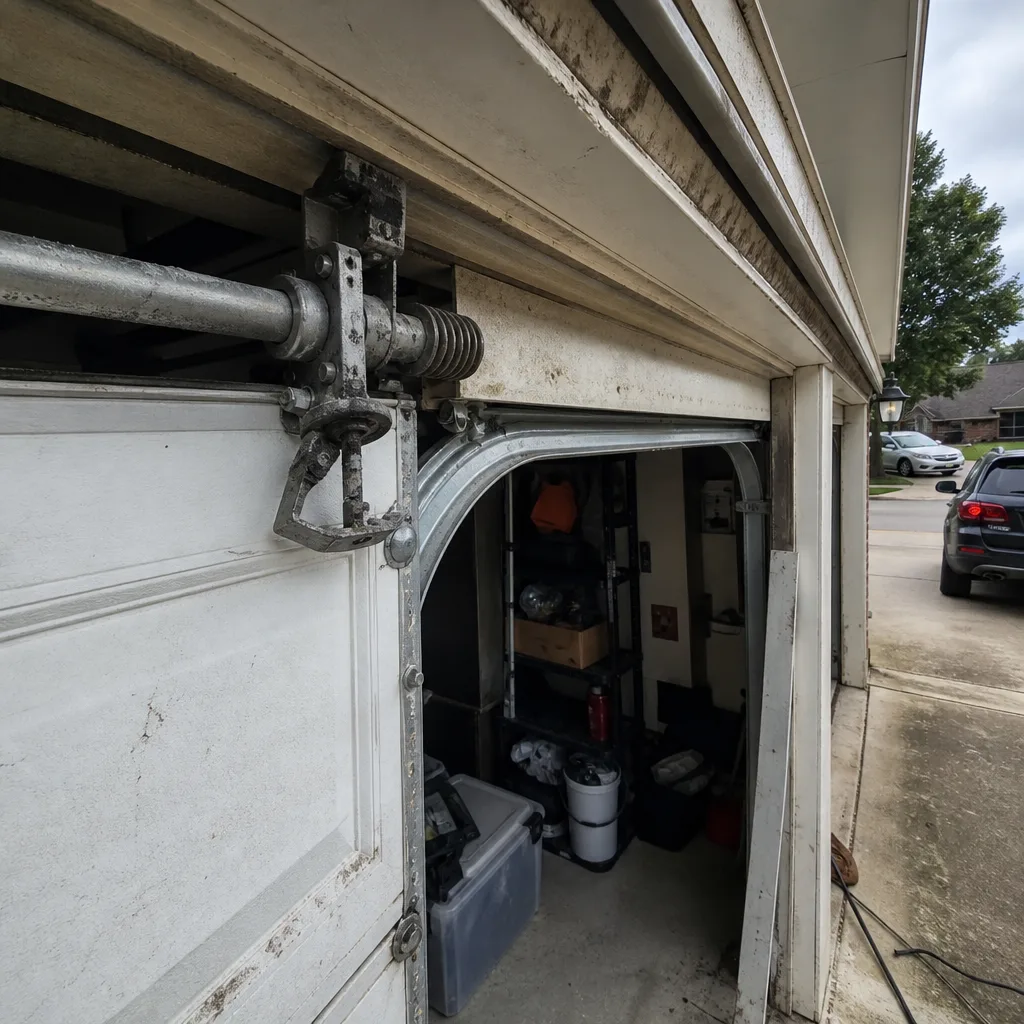 Before
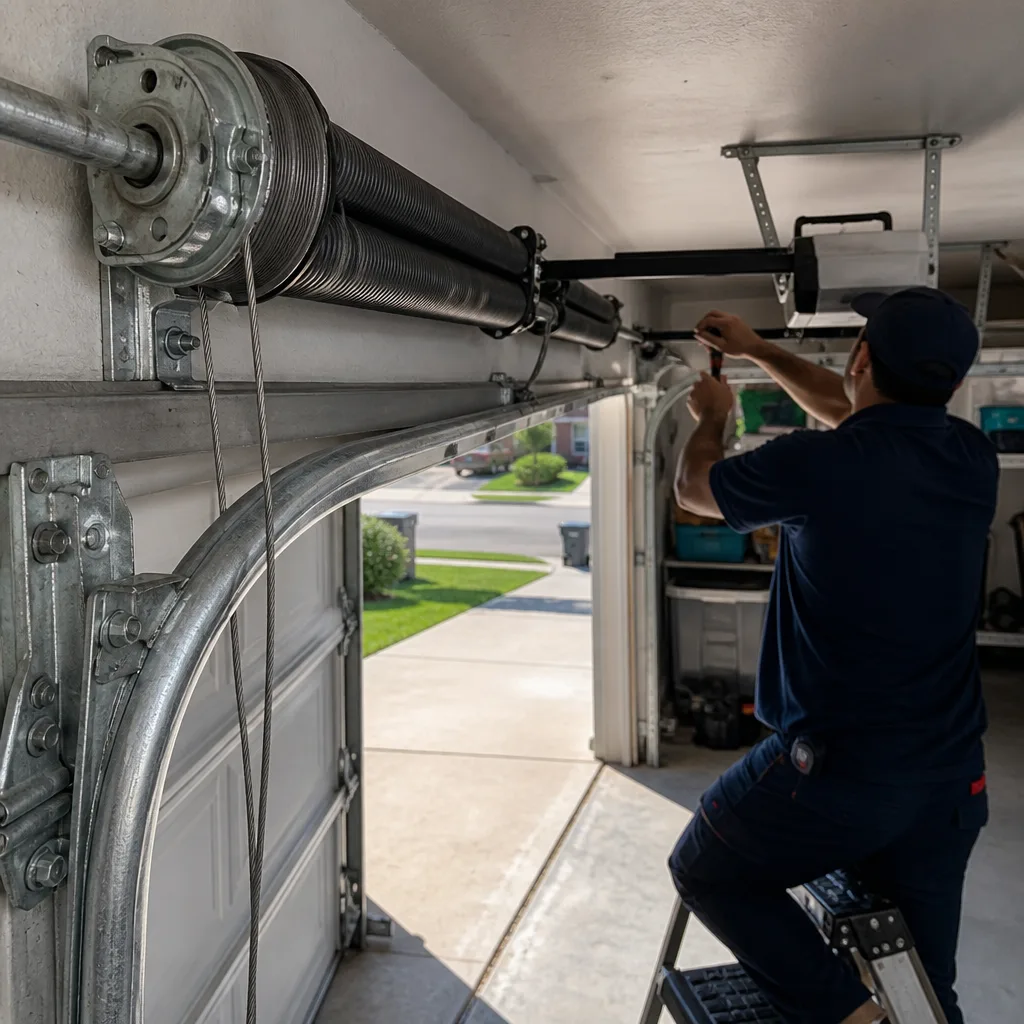 After
After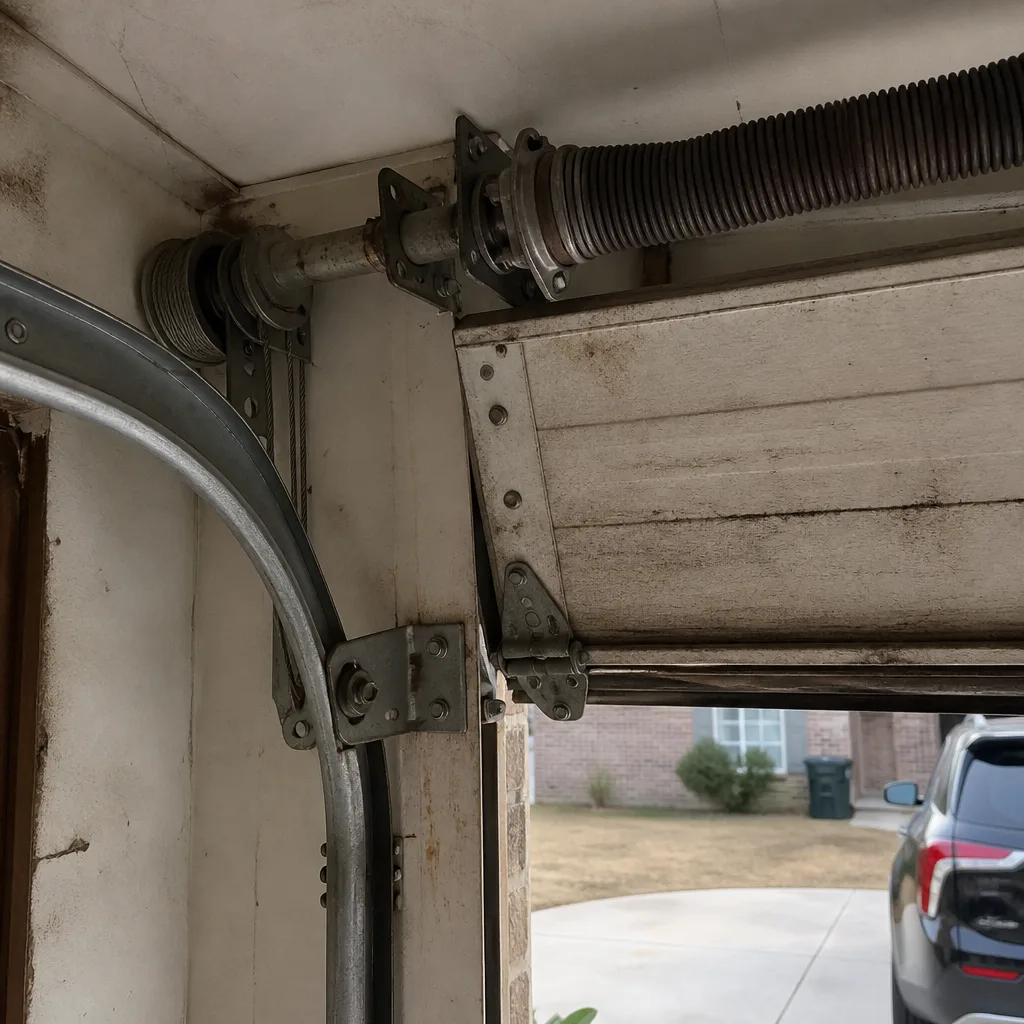 Before
 After
After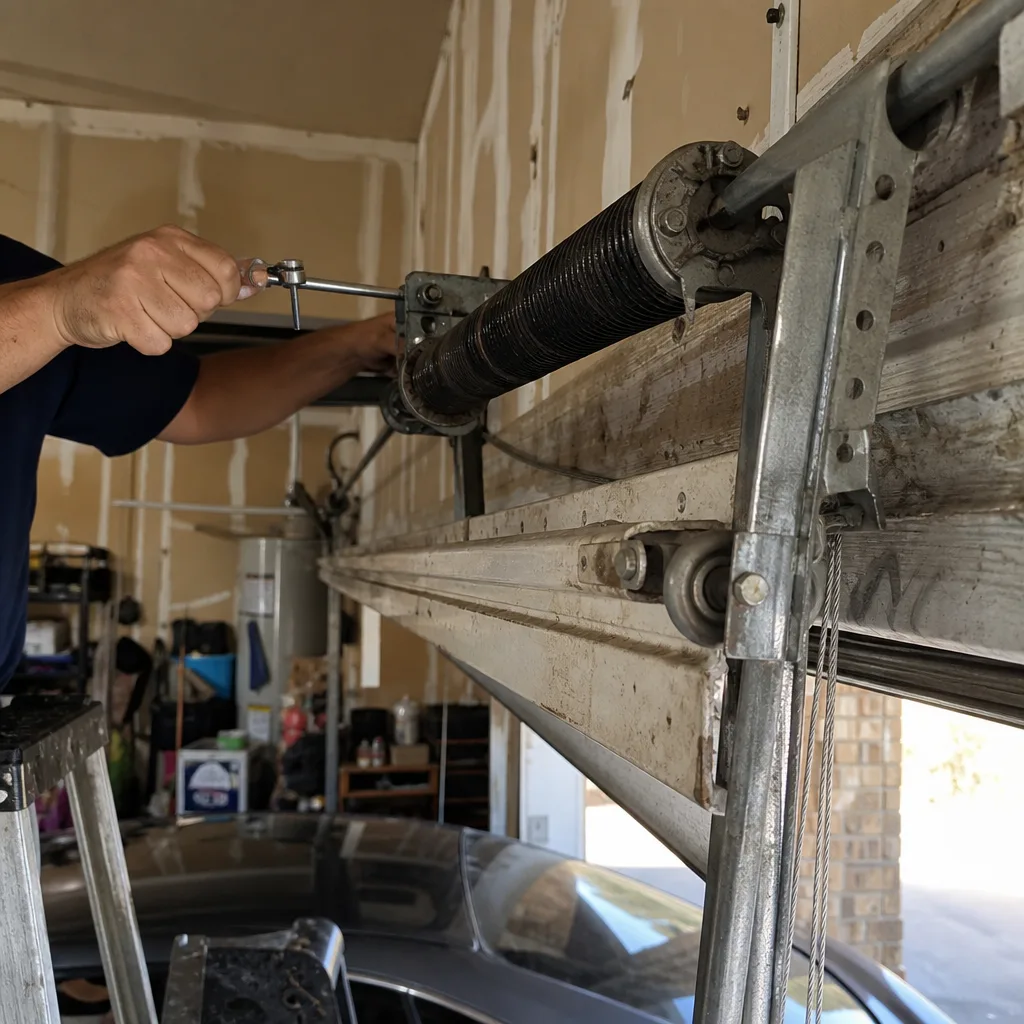 Before
 After
AfterSeasonal Garage Door Care for McKinney: Year-Round Homeowner’s Guide
The torsion spring failure rate in McKinney peaks in late October and early March, not because of cold, but because rapid 40-degree temperature swings in those months cycle metal tension more aggressively than sustained heat ever does. A spring rated for 10,000 cycles can fail at 6,000 if those cycles happen under repeated thermal expansion and contraction. This guide rebuilds the maintenance schedule around North Texas’s actual conditions, so you’re checking the right things when the weather actually stresses them, not when a calendar tells you to.
Quick Answer
Seasonal garage door maintenance in McKinney means inspecting and lubricating the torsion springs, rollers, hinges, and weatherseal on a schedule built around North Texas hail season, summer heat, and fall temperature swings, not generic four-season advice. The highest-risk windows are March through May for pre-hail hardware checks, June through September for opener circuit board and nylon roller monitoring, and October through November for torsion spring visual inspection before the first sharp cold front.
Table of Contents
- Spring Pre-Storm Season (March-May): Inspections Before Hail Season
- Summer Heat Load (June-September): What 95°F+ Does to Openers and Rollers
- Fall Temperature Swings (October-November): The Highest Spring-Failure Window
- Winter Freeze Events (December-February): Weatherseal and Cable Drum Checks
- Post-Hail Protocol: The Inspection Sequence After a McKinney Storm
- Lubrication Schedule for McKinney’s Dust and Heat
- Common Mistakes to Avoid
- When to Call a Professional
- Frequently Asked Questions
BeforeAfterSpring Pre-Storm Season (March-May): Inspections Before Hail Season
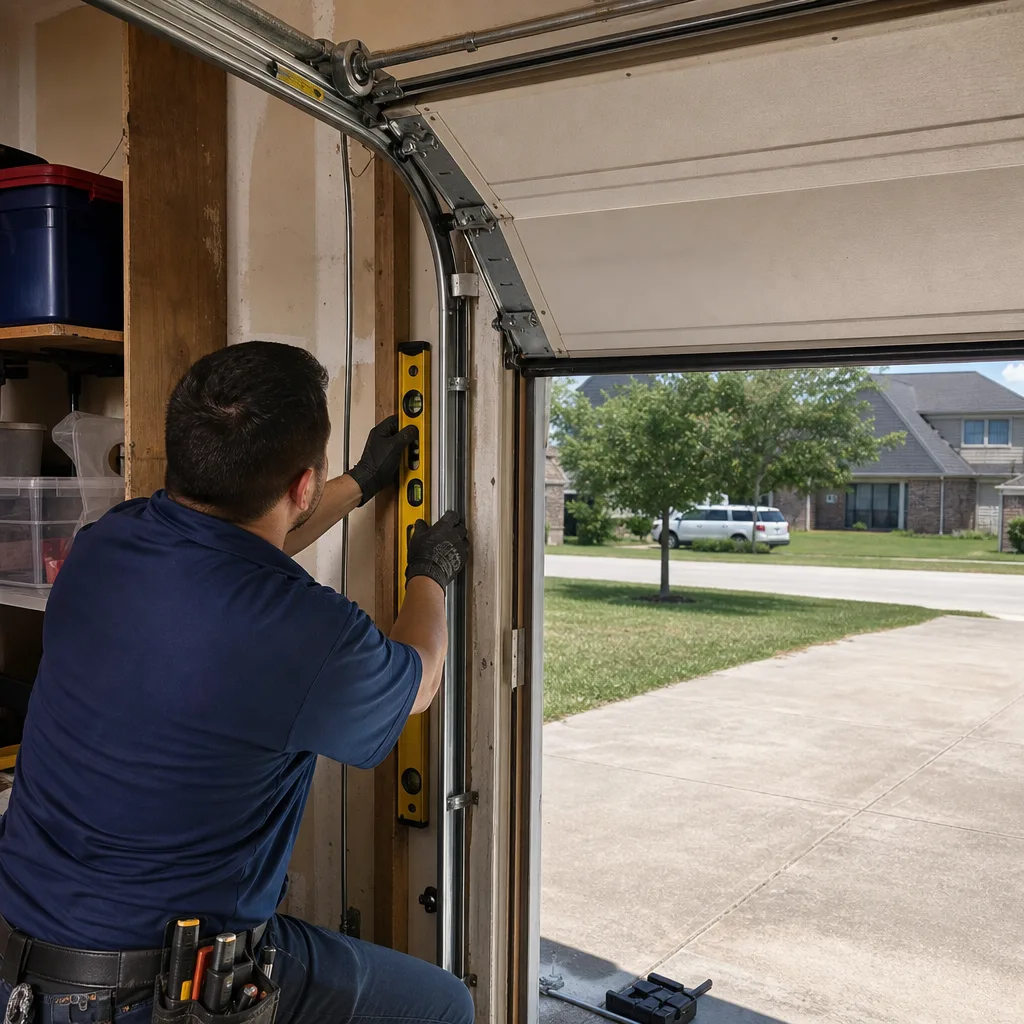
McKinney’s hail season runs from mid-March through late May, and the storms that roll through Collin County bring wind gusts that stress every fastener on a garage door assembly. The pre-storm inspection is not about finding broken parts, it’s about finding loose ones before a 60 mph gust turns a loose hinge into a bent track. We’ve seen doors in Stonebridge Ranch and Eldorado that worked fine in February fail during the first March thunderstorm because a hinge bolt had backed out half a turn over the winter.
Here’s the pre-storm inspection sequence we recommend for McKinney homeowners:
- Hinge and bracket bolts: Use a 7/16-inch socket to check every hinge bolt where panels connect and every bracket bolt where the track mounts to the wall. Tighten anything with visible play. A loose track bracket under wind load is how doors get pulled out of alignment.
- Track alignment: Look down both vertical tracks from inside the garage. The gap between track and door edge should be consistent the full height. If it narrows at any point, the track has shifted and the rollers are wearing against the metal.
- Roller condition: Nylon rollers with visible cracks or flattened spots should be replaced before hail season, not after. A roller that seizes during a storm cycle can snap the roller stem and drop the door onto the track.
- Weatherseal integrity: The bottom seal and the side jamb seals are your dust and water barrier. March is the last month with predictable rain before the dry heat sets in. If the seal is cracked or compressed flat, replace it now.
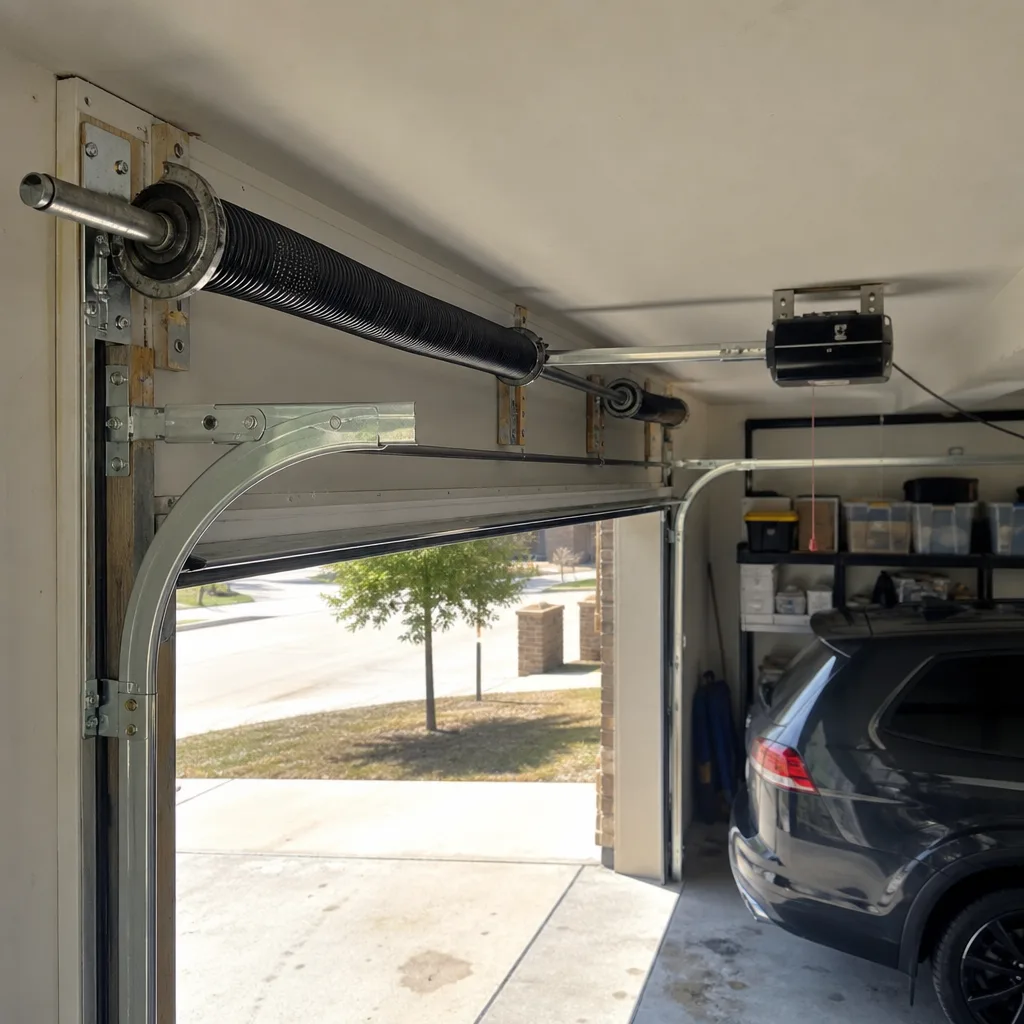
- Torsion spring visual check: Wipe the spring coils with a rag and look for rust scoring, uneven coil spacing, or a visible separation line. These are early warning signs the spring is near end of life. Do not touch the spring itself, the tension carries enough stored energy to cause serious injury.
The other thing March brings in McKinney is the start of pollen season, and that fine yellow dust works its way into the roller bearings and hinge pins. A dry silicone lubricant applied in early March creates enough of a barrier to keep the pollen from packing into the moving surfaces. We recommend a dry lubricant rather than a wet grease because North Texas dust and humidity turns grease into an abrasive paste within two months.
If you find loose hardware or a track that’s out of alignment during this inspection, the fix is straightforward now but expensive later. A track adjustment in March might be a half-hour service call. The same problem after a storm has pulled the track off the wall is a full track replacement. Many homeowners in McKinney schedule a seasonal inspection with Garage Door Repair in McKinney during this window specifically to catch loose hardware before the first severe thunderstorm. At Servo, every seasonal inspection includes a documented photo record of what we found, so you’re not taking our word for it. You’re looking at the same bolt we looked at.
Summer Heat Load (June-September): What 95°F+ Does to Openers and Rollers
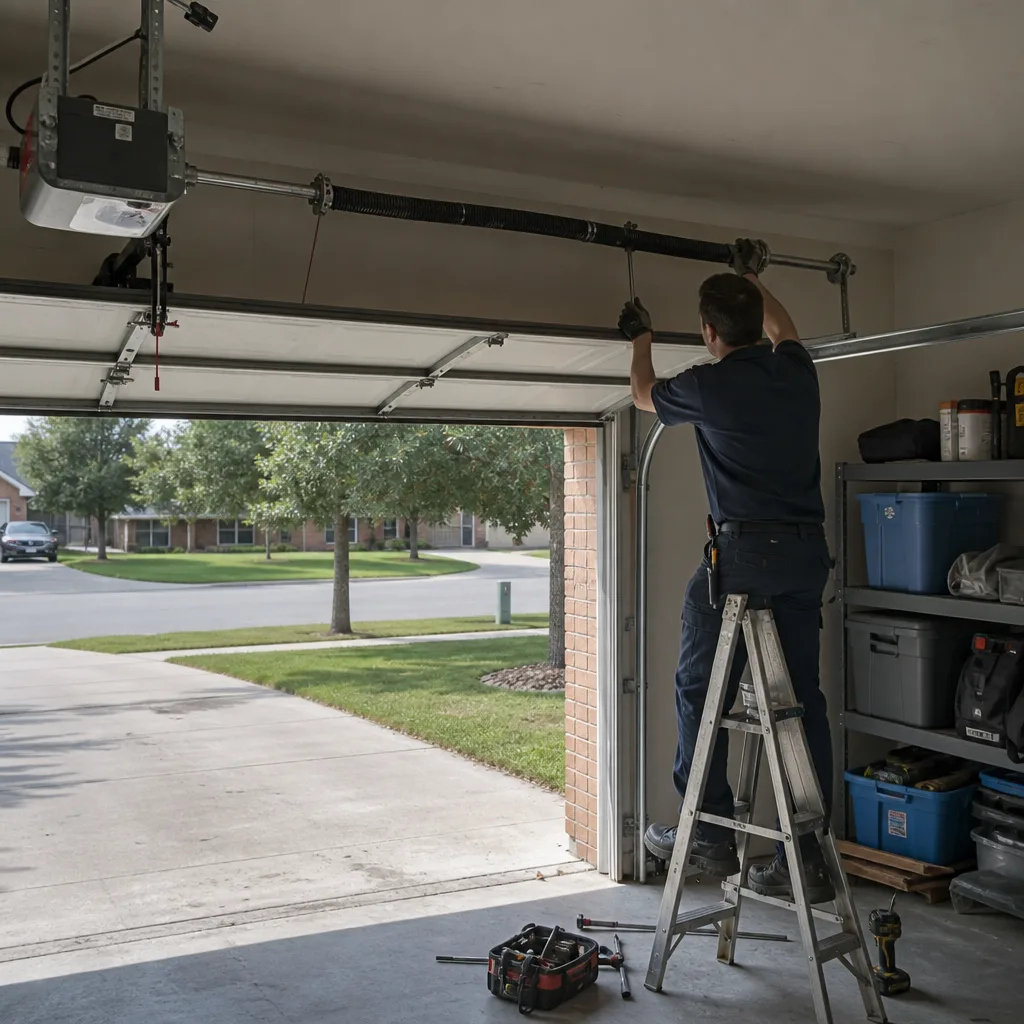
McKinney summers consistently push garage temperatures 20 to 30 degrees above the outside air temperature, meaning an opener mounted to the ceiling is operating in sustained 115°F to 125°F heat for three months. That heat does three specific things: it degrades the electrolytic capacitors on the opener’s logic board, it causes nylon rollers to soften and develop flat spots faster than rated, and it compresses the bottom weatherseal so it never fully rebounds, which lets dust and insects in through the fall.
The logic board capacitor issue is the one most homeowners never see coming. LiftMaster and Chamberlain openers use capacitors rated for 85°C sustained operation, and a McKinney garage ceiling in August will push the board’s ambient temperature toward 70°C. Ten or twelve consecutive days above 100°F outside is enough to push the board past its rated range for hours at a time. When the capacitor degrades, the symptom is an opener that works intermittently in the afternoon heat and then works fine once the garage cools off at night. If you notice your opener doing anything inconsistent in July or August, the circuit board is the first place we look. It’s also why we recommend not storing temperature-sensitive items like paint, vinyl records, or some electronics in a McKinney garage without insulation.
The rollers are the second heat casualty. Nylon rollers are rated for quieter operation and longer life than steel, but sustained heat above 100°F softens the nylon enough that the roller develops flat spots from the garage door’s weight sitting on it at rest. A flat-spotted roller sounds like a rhythmic thumping as the door moves. If you catch the flat spot early, you replace a $10 roller. If you ignore it, the flat spot wears the inner race and the roller seizes, which then forces the track and can pull a section out of alignment. The inspection is simple: run the door up and down and listen for a thump that repeats on every cycle in the same position.
The weatherseal compression is slower and less dramatic, but it matters for what comes in the fall. A door weight of 200 to 400 pounds pressing down on a rubber seal in 120°F heat compresses that seal until it takes a set. Once it takes a set, it does not recover when the temperature drops. The visual test is to close the door and look along the bottom edge from the outside. If you can see daylight or a gap wider than a quarter inch at any point, the seal is no longer sealing. In McKinney’s blackland prairie soil, that gap is how scorpions and fire ants come in off the slab during summer nights and how the first October cold front’s dust finds its way into your garage.
Summer monitoring is passive, and that’s the point. You’re not doing heavy maintenance in June through August. You’re watching for the three heat-specific failure modes: intermittent opener behavior, rhythmic thumping from the rollers, and a compressed bottom seal that leaves a visible gap. If you see any of them, address it before October. The fall temperature swing amplifies every small summer problem into a larger one.
Fall Temperature Swings (October-November): The Highest Spring-Failure Window
The dominant garage door failure mode in McKinney is not the summer heat and not the winter freeze. It’s the rapid temperature swing in October and November. A torsion spring is a coil of tempered steel wire that stores tension. Every time the garage door cycles, that coil flexes. Every time the temperature changes 40 degrees in 12 hours, which McKinney does routinely in October, that steel expands and contracts against the tension load. The spring is simultaneously being pulled by the door’s weight and pushed by the temperature change. The failure point is not graceful. It’s a clean break, usually at the coil, and it sounds like a gunshot through the garage when it lets go.
In our experience across McKinney, from Adriatica to Trinity Falls, the first cold front of mid-October is the highest single-day spring failure spike of the entire year. The technical reason is stress accumulation: the spring has been heat-cycled all summer, the coils have been expanding and contracting hundreds of times, and the first sharp drop into the 40s overnight adds a sudden contraction against the tension. The metal had been tolerating it incrementally. The cold front makes it cumulative.
The visual warning sign before a break is called coil separation. Here’s how to check for it without touching the spring:
- Close the garage door fully so the spring is under maximum tension.
- Stand to the side of the spring, never directly in front of it or underneath it.
- Look at the coils. A healthy torsion spring has coils that sit flush against each other with no gaps. A spring near end of life shows a visible gap between two coils, usually 1/8 inch or smaller, where the wire has stretched slightly and separated.
- Run your eye along the full length. The separation usually starts near the center of the spring or at the stationary cone, not at the ends where the winding cone sits.
- Check the gap width. If the gap is wider than 1/16 inch and you see any rust or pitting on the wire at that point, the spring is not going to last the season.
What triggers a spring replacement in McKinney is usually not age, it’s cycle count. A standard 10,000-cycle spring on a door that runs 4 to 6 full cycles per day lasts roughly 5 to 7 years. If you’ve never replaced your springs and you bought the house before 2020, you’re in the replacement window. If you see coil separation, don’t wait and don’t cycle the door more than necessary. When a torsion spring breaks under load, it can damage the cable drum, the cables themselves, and the opener carriage before the door settles onto the safety reverse or the floor. That’s a $180 to $340 spring job turned into a much larger repair. Servo Garage Doors McKinney home covers spring replacement the same way we cover every job: we photograph the failed component at Clause 4, we give you a flat written price before any work starts per Clause 1, and the 365-Day Done Right Promise applies in writing.
For a deeper explanation of the full failure chain, see our Garage Door Repair in McKinney page, which walks through each component and what it costs to fix in McKinney’s market.
Winter Freeze Events (December-February): Weatherseal and Cable Drum Checks
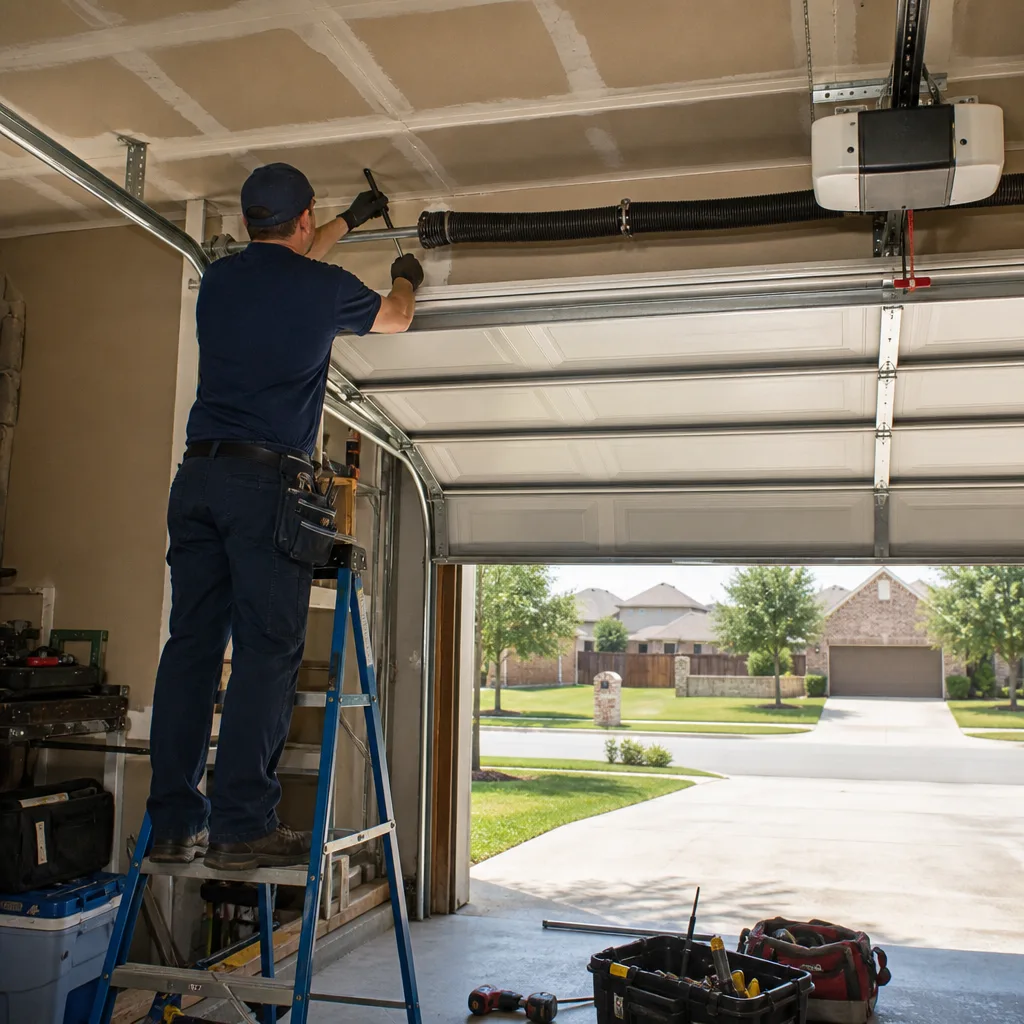
McKinney winters are mild compared to the Midwest, but the freezes are sharp and sudden. A night in the teens after a week in the 50s is enough to affect two specific components: the bottom weatherseal and the cable drum on the torsion shaft. The damage is usually small, and most homeowners do not notice it until spring.
The bottom weatherseal on most McKinney garage doors is a T-style rubber extrusion slid into a retainer channel at the bottom of the door. Rubber that has already been heat-compressed during summer loses flexibility in a freeze. If the seal has bonded to the concrete from condensation that froze overnight, the first morning opener cycle will tear the seal out of the retainer channel or rip it along the bottom edge. The symptom is a seal that hangs loose at one corner or has a visible tear. A torn seal lets cold air, rain, and pests through all winter and into the spring.
If you have a Raynor or Craftsman door with an aluminum retainer channel that’s been on the house since before 2015, inspect the channel itself. The aluminum contracts in cold weather at a different rate than the rubber inside it, and over repeated freeze cycles the channel can open slightly at the end caps and release the seal. The same mismatch is why we recommend replacing a 10-year-old weatherseal in September or October rather than waiting for the first freeze to reveal it.
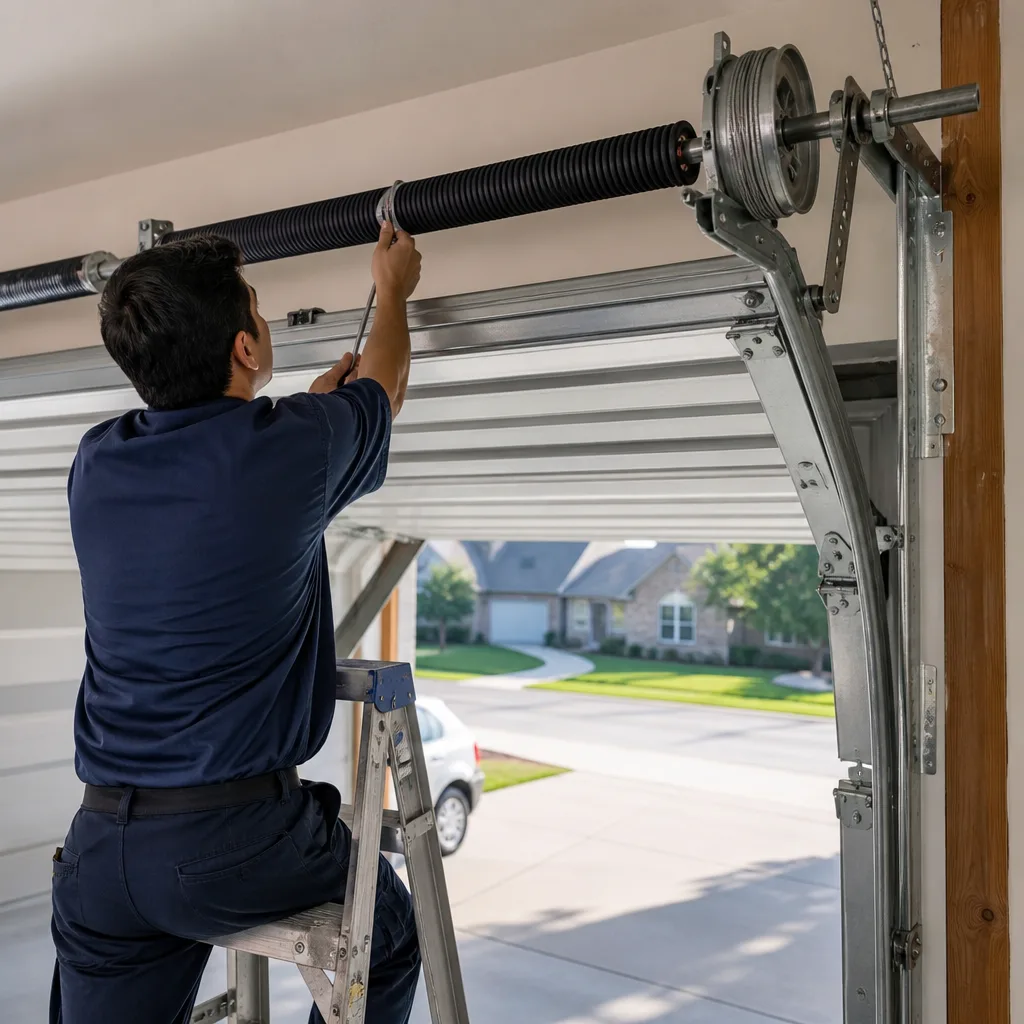
The cable drum on the torsion shaft is the second winter wear point. The drum is the circular spool at each end of the shaft where the lifting cable wraps. In sustained cold, the galvanized steel cable contracts, and if the drum has any surface rust or a worn groove from previous contact with the frame, the cable can jump the groove and wrap unevenly. When that happens, one side of the door lifts faster than the other. The door cocks visibly in the tracks, and if you keep cycling it, the cable will fray against the drum edge and eventually snap. A snapped cable releases all the tension on that side, and the door drops hard. This is not a DIY fix under any circumstances. The torsion shaft carries enough stored tension to cause serious injury, and a cable that’s jumped the drum needs a trained technician to reseat it safely.
The winter inspection is short: run the door once on a cold morning and watch for level movement, listen for cable scraping inside the track, and look at the bottom seal after the door opens. If the door is level and quiet and the seal is intact, leave it alone. If you see any cable fraying, any uneven movement, or a seal that has torn free, address that before the February freeze pattern repeats.
Post-Hail Protocol: The Inspection Sequence After a McKinney Storm
McKinney’s hail is the most predictable unpredictable event in North Texas homeownership. The March 2016 storm that dropped golf ball hail on the west side of the city did structural damage to garage doors that did not fully reveal for months. The sequence that follows any hail event, regardless of storm severity, should become a habit.
The core principle is this: a garage door that still opens and closes after hail is not necessarily an undamaged garage door. Panel denting changes the door’s weight distribution, and weight distribution changes the torsion spring’s load calculation. The spring was wound to counterbalance a specific door weight. Add 0.5 pounds of impacted metal deformation across four panels, and the spring is now under-wound for the actual load, which means the opener is lifting the difference. That difference shortens opener life and spring life, and it increases the wear on the rollers as they pass over dented panel sections.
Here’s the post-hail inspection sequence we run on McKinney garage doors, and the one we recommend you run as a homeowner:
- Panel surface check: In direct sunlight, look across each panel at a shallow angle. Hail dents that are invisible from straight on show up clearly as shadows when you look across the surface. Note the location and count.
- Panel seam check: Run your eye along each horizontal seam where panels meet. Hail impact on the panel face often causes the seam to bow slightly, which is where the door loses structural rigidity.
- Balance test: Close the door, pull the release handle to disconnect the opener, and lift the door manually to waist height. It should stay put, or move no more than 2 to 3 inches either direction. If it slides down, the door gained weight from the impact and the spring tension is now wrong.
- Opener cycle test: Run the door through a full cycle and listen for the opener motor strain. If the opener that was quiet before the storm now sounds labored, it’s compensating for the unbalanced panel load.
- Track and roller check: Watch the rollers as they pass through the curved track section at the top of the door. If any roller jumps or snags, the track was tweaked by the storm’s wind pressure or the panel deflection has shifted the roller’s alignment.
The documentation angle matters here because most insurance claims for garage door hail damage in McKinney are decided on photos. The photo record Servo provides on every visit has been used by homeowners to substantiate claims that would otherwise have been denied as pre-existing damage. If you document the door’s condition before hail season, the post-storm comparison is straightforward.
If the door still opens and closes but the balance test fails, the spring needs re-tensioning to the new door weight, or the panels need replacement if the denting is structural. For a full treatment of what hail damage repair costs, our Garage Door Repair in McKinney page has a component-by-component pricing breakdown. The post-storm protocol is also the time to consider whether the door’s age and damage justify a full Garage Door Installation in McKinney rather than patch repair. A 15-year-old door that took a direct hit on four panels will rarely be worth panel replacement at $400 to $900 per panel when a new insulated steel door runs $1,200 to $2,500 installed and comes with a manufacturer warranty.
Lubrication Schedule for McKinney’s Dust and Heat
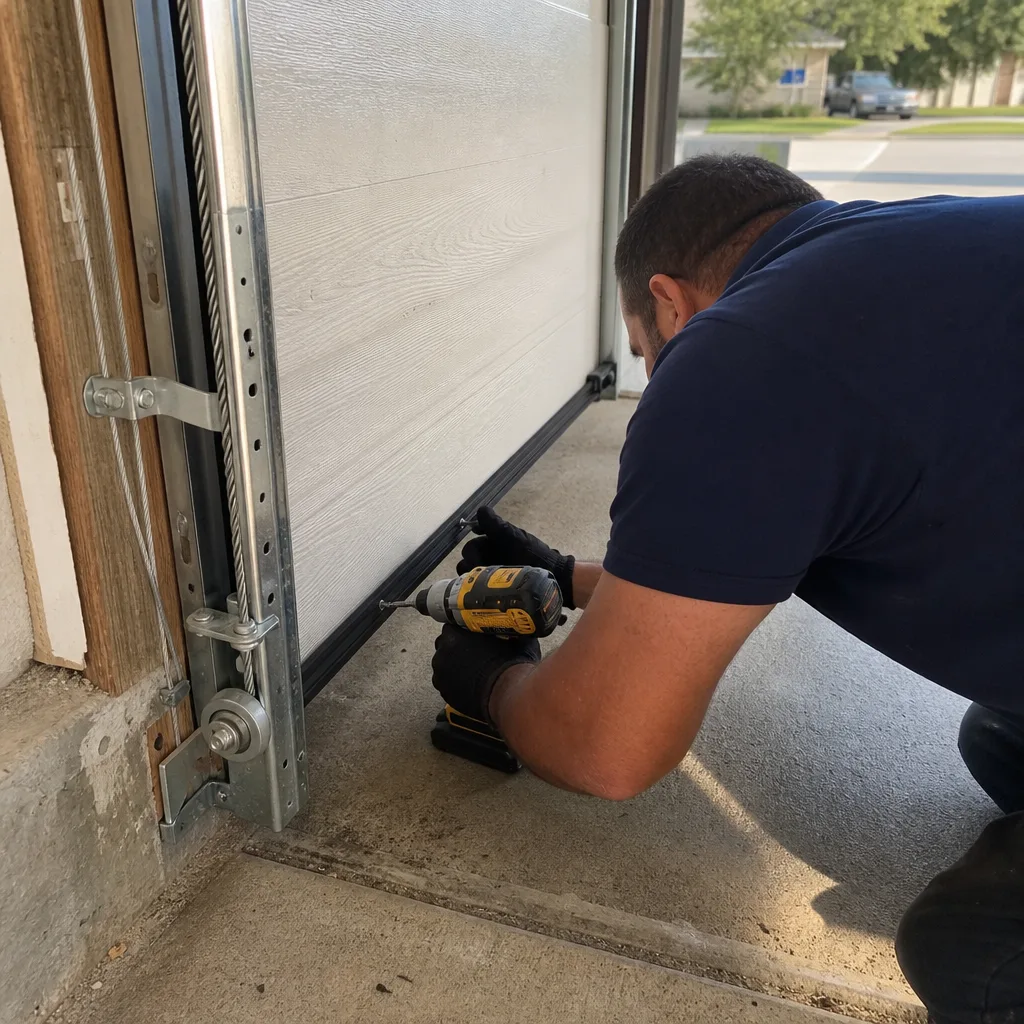
Most garage door lubrication advice is written for climates that do not have McKinney’s combination of fine clay dust, summer humidity, and sustained heat. A petroleum-based grease applied to the torsion spring in April will collect clay dust all summer and become a grinding compound by August. We recommend a dry PTFE or silicone spray, applied on a specific schedule tied to McKinney’s weather, not to an arbitrary interval.
The lubrication points on a standard sectional door are the torsion spring coils, the roller bearings, the hinge pins, and the lock mechanism if you use one. The opener rail, for screw-drive and belt-drive units, gets a different treatment depending on the brand. LiftMaster belt-drive openers need no rail lubrication on the belt itself; lubricating the belt degrades it. The tensioner and the trolley carriage get a light touch. Chamberlain chain-drive openers do get a light oil on the chain, but only enough to make it glisten, never enough to drip.
The schedule we use for McKinney:
- Early March: Full lubrication pass before pollen season. Dry silicone on springs, rollers, and hinges. Light oil on chain if applicable. This is the pre-hail season prep.
- Mid-June: Re-apply dry silicone to the torsion spring only. The summer heat burns off the carrier quickly, and the spring is the one component that cannot be replaced with a $10 part.
- Late September: Full pass again before the fall temperature swing window. This is the most important lubrication of the year because the spring will be cycling through the highest stress period.
- After any haboob or heavy dust event: McKinney occasionally gets dust storms that blow in from the west. After any event that leaves visible red dust on your car, wipe down the torsion spring and re-lubricate. Clay dust is abrasive and electrically conductive, and neither property helps a spring.
If you’re doing the lubrication yourself, wear safety glasses and keep both feet on the ground. Never use a ladder against the door itself, and never reach through the spring coils with a rag. The spring is under tension even when the door is closed. A rapid release of that tension is the single most common garage door injury mechanism in North Texas, which is why we frame every maintenance step as “what to check” rather than “how to fix” when the torsion assembly is involved.
Common Mistakes to Avoid
- Lubricating with WD-40 thinking it’s a garage door lubricant. WD-40 is a solvent and water displacer, not a lubricant. It strips the existing lubrication and leaves the surface dry within a week. Use a dry PTFE or silicone product formulated for garage doors.
- Using a calendar-based schedule that ignores McKinney’s weather events. A door inspected on a “first day of spring” schedule will be checked in late March, which is often after the first hail event has already hit. The trigger should be the weather forecast, not the date.
- Dismissing hail dents as cosmetic. Even shallow panel denting changes the door’s weight and shifts load to the opener and spring. The balance test is free, takes 30 seconds, and tells you whether the spring is now under-wound for the actual door weight.
- Ignoring intermittent opener symptoms in summer heat. An opener that works in the morning and fails in the afternoon heat is telling you the logic board is on the way out. The failure usually becomes permanent on the hottest day of the year, which is also when you need the garage door to work.
- Attempting to adjust torsion spring tension or reposition a cable without the proper winding bars and training. The torsion assembly stores enough energy to break bones or cause fatal injury. In McKinney, there is no reason to take this risk; a professional spring adjustment is a service call, not a major repair.
- Leaving a torn bottom seal through winter. The torn seal does not self-heal, and the gap expands with every freeze cycle. By spring, the seal has degraded enough that you’re also dealing with dust, pests, and higher cooling costs in the garage’s conditioned boundary.
- Assuming a new door means no maintenance for years. A new Clopay or Amarr door still needs seasonal lubrication and annual balance checks. The manufacturer’s warranty covers defects, not neglect, and the thermal cycling in McKinney’s climate accelerates wear on every moving component.
When to Call a Professional
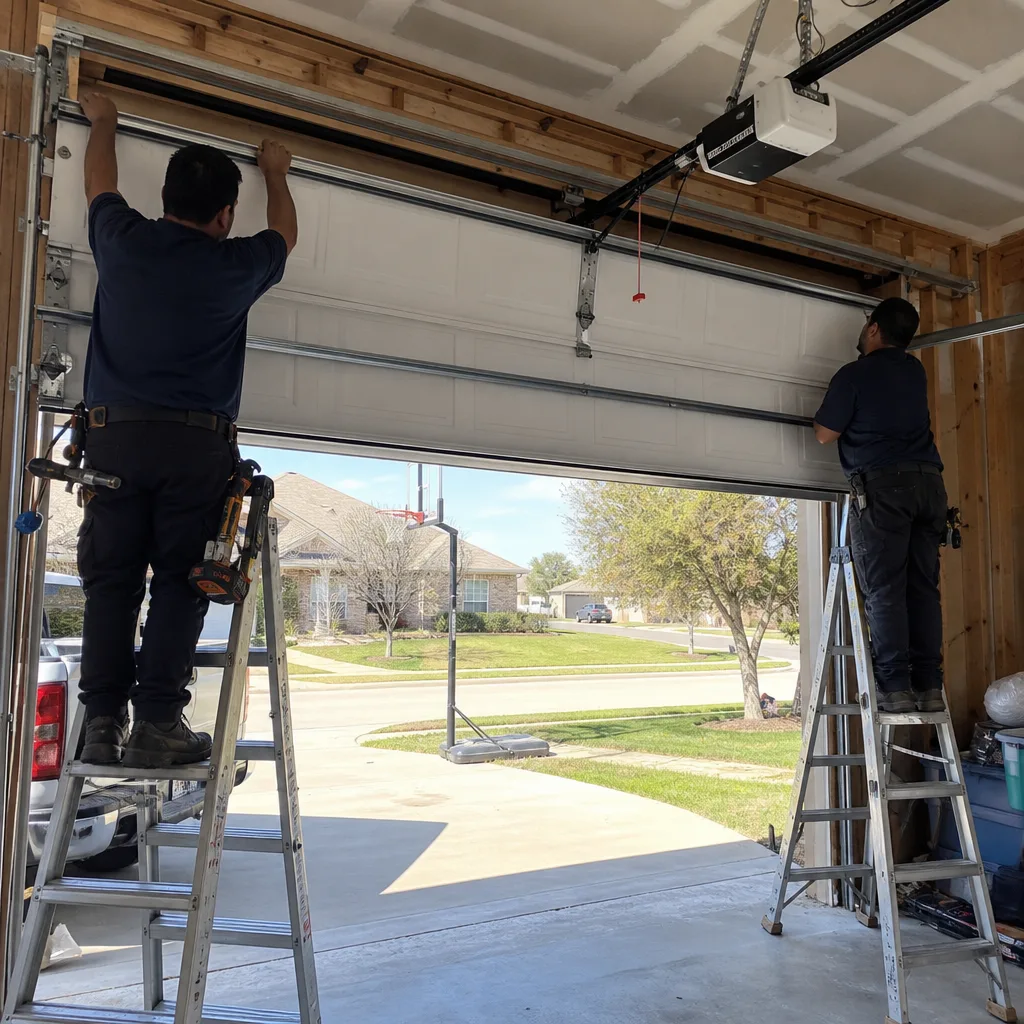
Call a professional when the spring shows visible coil separation, when the door fails the balance test after a hail event, when a cable has jumped the drum or shows fraying, when the opener has intermittent symptoms that persist after a capacitor cool down, or when any repair involves the torsion assembly. These are not YouTube-friendly fixes, and the cost of a failed DIY attempt is routinely higher than the repair would have been. Servo Garage Doors McKinney gives every customer a free estimate, and the estimate includes a written price and a written scope before any work begins. Call (469) 815-7610 and we’ll put you on the schedule with a named technician, not a callback window.
Frequently Asked Questions
Lubricate the torsion spring, rollers, and hinges three times a year in McKinney: early March before pollen season, mid-June during peak heat, and late September before the fall temperature swing window. Use a dry PTFE or silicone spray, never WD-40 or petroleum grease, which collect clay dust and become abrasive within months. Call (469) 815-7610 if you want this done as part of a seasonal inspection with a documented photo record.
McKinney’s summer garage temperatures exceed the rated operating range of most opener logic boards, and the electrolytic capacitors on the board degrade under sustained heat, causing intermittent operation that worsens in the afternoon. If your LiftMaster or Chamberlain opener fails only during heat waves and works after the garage cools, the circuit board is the likely culprit. A technician can confirm it with a board inspection, and the fix is usually straightforward.
A torsion spring nearing failure shows visible coil separation, which is a gap wider than 1/16 inch between two coils, usually near the center or at the stationary cone. You may also see rust scoring or pitting on the wire at that point. The check must be done from the side with the door closed and the spring under tension, never from directly in front of it. If you see separation, schedule replacement before the next large temperature swing. Call (469) 815-7610 for a free estimate with a flat written price before any work starts.
Yes. Hail dents change the door’s weight distribution, which de-tunes the torsion spring’s counterbalance load, which then forces the opener motor to work harder on every cycle. The extra strain shortens the opener’s gear and motor life, and it also accelerates roller wear as the rollers pass over dented panel sections. Run the balance test after any meaningful hail event to quantify the change.
A seasonal inspection in McKinney typically ranges from $75 to $150 for a full hardware check, lubrication pass, and balance test, depending on whether any minor adjustments are made during the visit. At Servo, the inspection includes a documented photo record of everything we found, which is the same documentation system we use on every job under The Haven Standard. Estimates for any recommended work are free. Call (469) 815-7610 for an exact quote on a seasonal inspection.
Lubrication, visual inspections, balance tests, and weatherseal checks are all safe for a homeowner to do with basic precautions: safety glasses, both feet on the ground, and no contact with the torsion assembly. Anything involving the torsion spring, the lifting cables, the cable drums, or the opener’s electrical connections should be left to a trained professional with the proper winding bars and experience. The tension stored in a wound torsion spring can cause serious injury if released incorrectly.
The Bottom Line
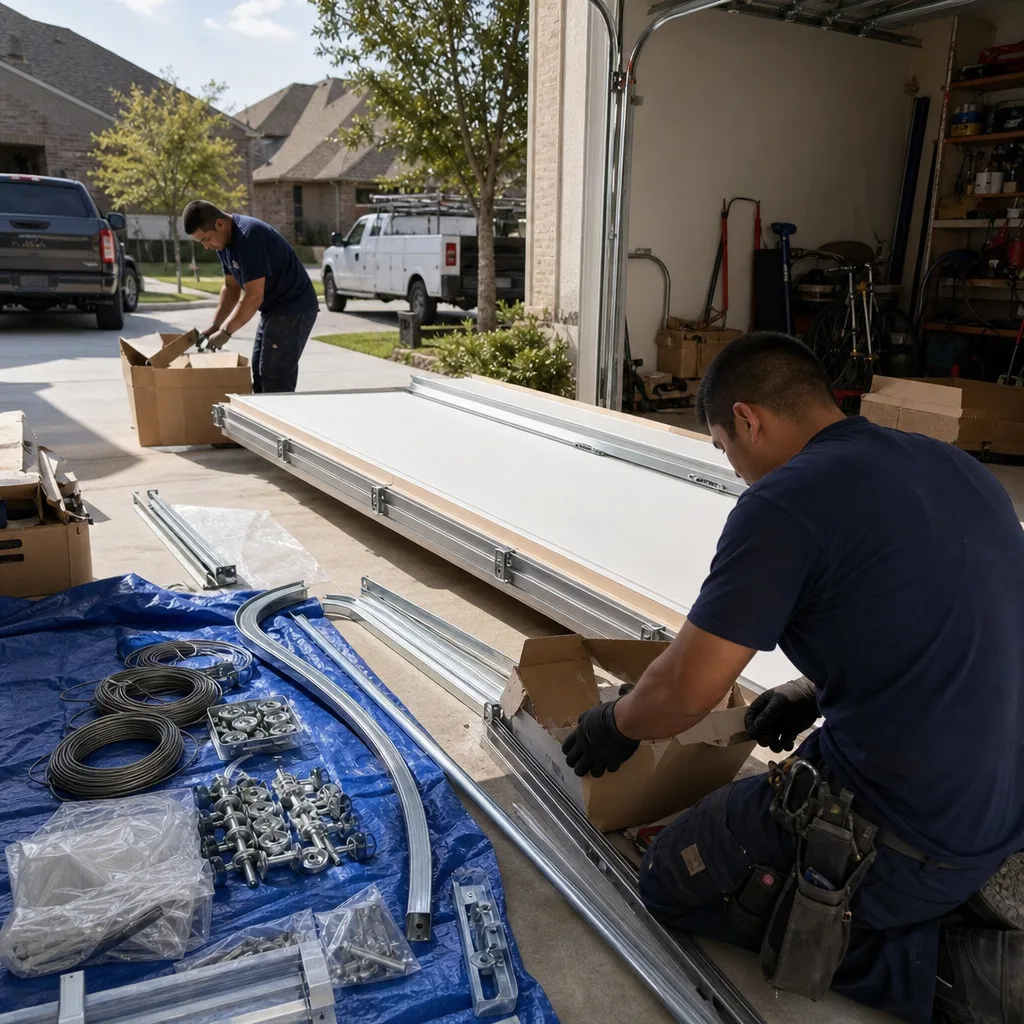
McKinney’s garage door stress calendar is not four seasons, it’s three windows: pre-hail spring tightening, summer heat monitoring, and fall temperature-swing spring inspection. The fall window is where most failures happen, and the pre-failure sign is visible coil separation on the torsion spring. If you do the three seasonal passes each year, keep the hardware lubricated with dry silicone, run the balance test after every hail event, and call a professional the moment you see spring gaps or cable fraying, a sectional garage door in McKinney will run 15 to 20 years before replacement. The maintenance is not hard; the discipline is in doing it on the weather’s schedule rather than the calendar’s. For a full component-level look at what fails and what it costs to fix, start with Garage Door Installation in McKinney for door replacement context or Garage Door Opener Repair & Installation in McKinney for opener-specific guidance.
Written by Marcus Deller, Owner at Servo Garage Doors McKinney, serving McKinney since 2015.